
The National Retail Federation released its 2026 winter holiday survey on October 20, and the headline number isn’t a spending forecast. It’s this one: 56% of shoppers say the economy is actively shaping how much they spend this season. That’s a majority, not a vocal minority, and it’s based on 8,094 U.S. adults surveyed October 1–7, not a guess.
Here’s what’s actually interesting about that number: it hasn’t made people spend less or skip the holidays. NRF’s separate forecast still projects holiday sales growing 4.2% over last year, to $1.013 trillion. People aren’t opting out. They’re changing how they get there — and the “how” is the part worth copying before Thanksgiving weekend hits.
What the 2026 Survey Actually Found
Among the 56% who say the economy is affecting their plans, the survey breaks down exactly what they’re doing differently:
- 43% plan to shop sales more often than they normally would
- 31% plan to comparison shop online more often
- 29% plan to use coupons more often
None of that is dramatic. Nobody’s cutting their list in half or skipping gifts for the kids. It’s small, repeatable behavior changes — the kind that only work if you’re tracking them somewhere instead of trusting memory. And the timing data backs that up: 43% of shoppers plan to start before November this year, up slightly from 42% last year, and 64% say they’ll do most of their actual shopping over Thanksgiving weekend itself.
Online remains the top destination at 53%, followed closely by grocery stores (43%), discount stores (43%), and department stores (42%). Top gift categories haven’t shifted much — gift cards (47%), clothing (44%), books and media (25%), and personal care or beauty (24%) still lead.
Why Starting Before November Isn’t About Procrastination
Of the people who said they’re starting early this year, 50% gave a specific reason: they want to spread their budget out over more paychecks instead of absorbing it all in one December credit card statement. Another 37% said the prices and promotions right now are too good to pass up and they don’t want to wait and lose them.
Compare that to the 46% of people waiting until November, who are mostly holding out for better prices and promotions later. Both groups are making a calculated bet — one is betting that spreading purchases out protects their budget better than one big sale window does, and the other is betting the sale window itself will beat what’s available now. Neither is wrong. But the “spread it out” group has one advantage the “wait for the big sale” group doesn’t: they actually know, today, what they’ve spent and what’s left, because spreading purchases out only works if you’re logging each one as it happens.
That’s the part that quietly separates people who stick to a holiday budget from people who find out in January that they overspent by $400. It’s not willpower. It’s whether anything caught the purchase the moment it happened, before the next one made it easy to lose count.

The Budget Breakdown That Matches What the Survey Describes
If you’re one of the 43% starting now, the mistake to avoid isn’t starting too early — it’s starting with a single number in your head (“I’ll spend around $800 total”) instead of a breakdown. A single total number feels like a budget but functions like a guess, because nothing stops gift #4 from quietly eating the money you meant for gift #7.
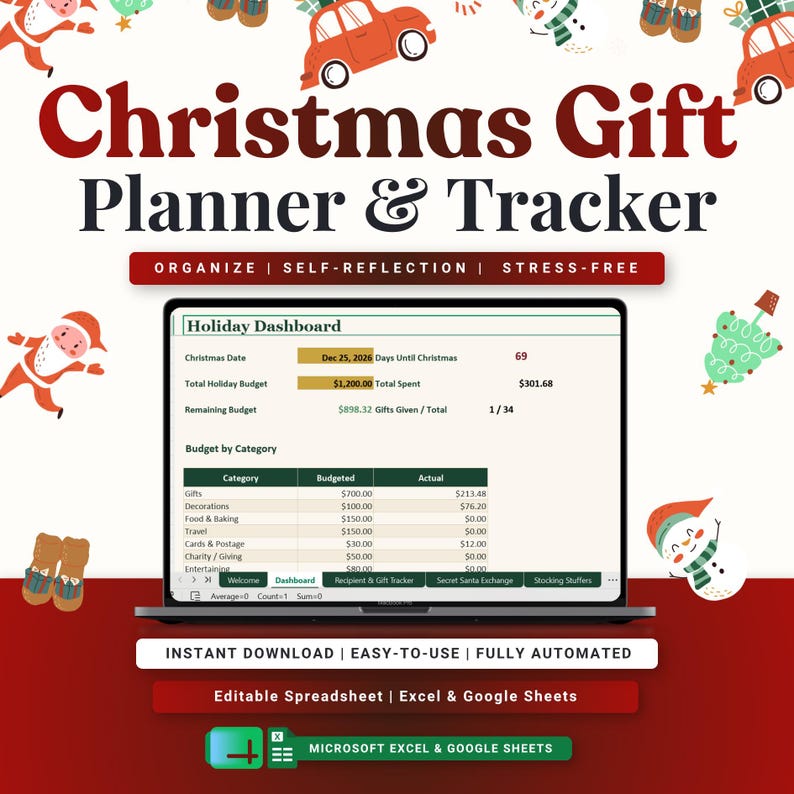
The version that actually holds up through December looks more like this: a per-person cap, a running total next to it, and a status column so you can see at a glance who’s covered and who still needs something. That’s essentially the structure behind this Christmas Gift Tracker spreadsheet from ThemindfullDesign — it has a live dashboard with a budget-vs-actual chart, a recipient-by-recipient tracker with price and status, plus separate tabs for stocking stuffers, Secret Santa exchanges, and the non-gift costs people forget to budget for, like wrapping, shipping, and postage. The point isn’t the specific tool. It’s the shape of it: nothing goes on the list without a dollar amount and a column for “did I already buy this.”
If you’re in the 29% planning to use more coupons this year, or the 31% comparison shopping online more, the same structure still matters — a coupon only saves money relative to a number you were already tracking against. “I got 20% off” isn’t a win if you don’t know what the pre-discount total would have pushed your per-person budget to.
Building the List So It Survives Thanksgiving Weekend
With 64% of shoppers saying they’ll do most of their buying over Thanksgiving weekend, the week before matters more than people treat it. That’s the window to get your list and budget set, not the week to start figuring it out from scratch while you’re also standing in a checkout line.
A short, practical setup before November 26: write down every person you’re buying for, assign each one a real dollar cap based on your total budget (not a guess, actual division), note one or two gift ideas per person now while your head is clear, and pick one place — a spreadsheet, a notes app, anything — where every purchase gets logged within the hour you make it, not “later tonight.” The delay between buying something and writing it down is exactly where holiday budgets quietly fall apart.
The economy isn’t stopping people from celebrating this year — the NRF’s own numbers prove that. It’s just changing which households go into December with a plan and which ones go in hoping it works out. Given that 91% of people surveyed still plan to celebrate the winter holidays regardless of what the economy is doing, the real decision in front of most shoppers right now isn’t whether to spend. It’s whether to track it.