
November is National Family Caregivers Month, and this year’s AARP numbers finally put a real price tag on what millions of people have been doing for free: family caregiving crossed $1 trillion in economic value for the first time, according to AARP’s 2026 “Valuing the Invaluable” update. That’s 59 million Americans caring for an adult family member, logging 49.5 billion hours in 2024 alone — the equivalent of 23.8 million full-time jobs, or about 17% of the entire full-time workforce, done without a paycheck, a title, or usually even a plan.
This year’s National Family Caregivers Month theme is “Care Connects Us,” and the Caregiver Action Network is using it to push something practical: caregivers don’t fail because they don’t love the person they’re caring for. They stall out because nobody handed them a system for the parts that have nothing to do with love — the documents, the phone calls, the forms that ask for information you don’t have memorized at 9pm on a Tuesday.
What $1 Trillion in Unpaid Care Actually Looks Like Up Close
The AARP report breaks the math down in a way that’s easy to skip past: the average caregiving hour was valued at $20.41 in 2024, up from $16.59 the year before, and that value swings by state — from $14.12 in Louisiana to $27.05 in Washington. Average family caregivers put in 27 hours a week, and 57% of them are in what the report calls “high-intensity” roles, meaning the caregiving isn’t a once-a-week check-in, it’s closer to a second job layered on top of the first one.
None of that shows up on a W-2. A separate AARP Public Policy Institute report cited alongside this one found home care and assisted living costs rose nearly 50% between 2019 and 2024, while the income of adults 65 and older grew only 22% in the same stretch. The gap between what care costs and what aging family members can actually pay is exactly where unpaid caregivers get pulled in — not because they signed up for a second job, but because the math didn’t work without them.

The Paperwork Nobody Warns You About
Ask anyone who’s actually done this and the complaint is rarely the caregiving itself. It’s the binder that doesn’t exist. Insurance policy numbers scattered across old mail. A Medicare card you can’t find when the hospital asks for it at 7am. A list of medications that lives only in someone’s memory, which is a problem the day that memory has a bad morning.
This is the unglamorous half of caregiving, and it’s the half that actually breaks people, because it has to be rebuilt from scratch every single time there’s a new doctor, a new emergency, or a new family member trying to help without knowing where anything is. A Household Emergency Binder that keeps medical, financial, and password information in one editable place isn’t a nice-to-have for a caregiving household — it’s the difference between finding an answer in thirty seconds or losing twenty minutes mid-crisis hunting through a kitchen drawer.
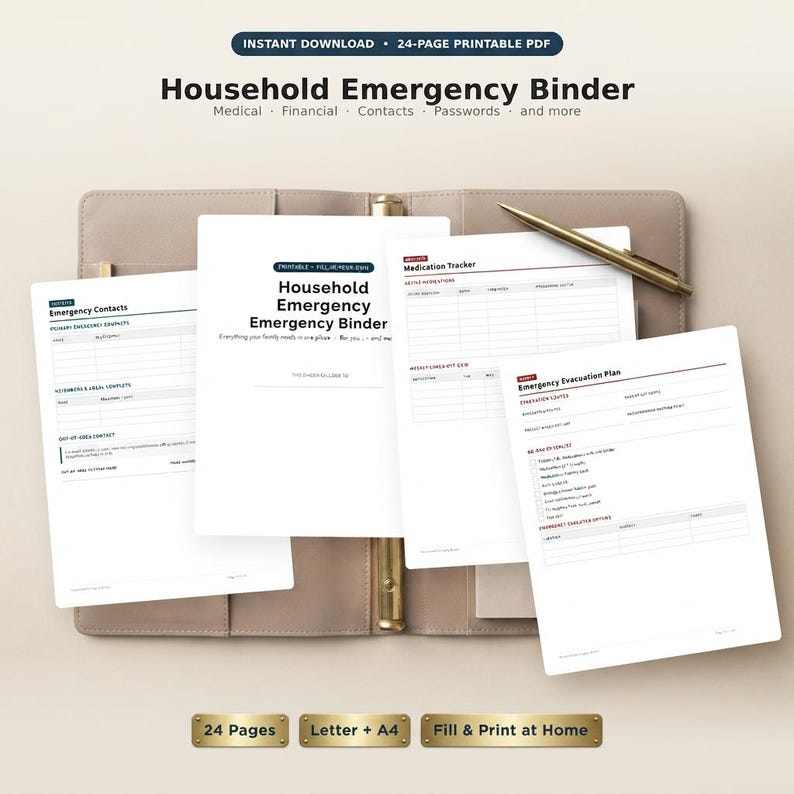
Set it up once, in a calm moment, not during the emergency it’s meant for. That’s the whole trick. Nobody fills out a binder well while they’re also on hold with a hospital billing department.
If You’re Caregiving Full-Time, You May Be Able to Get Paid for It
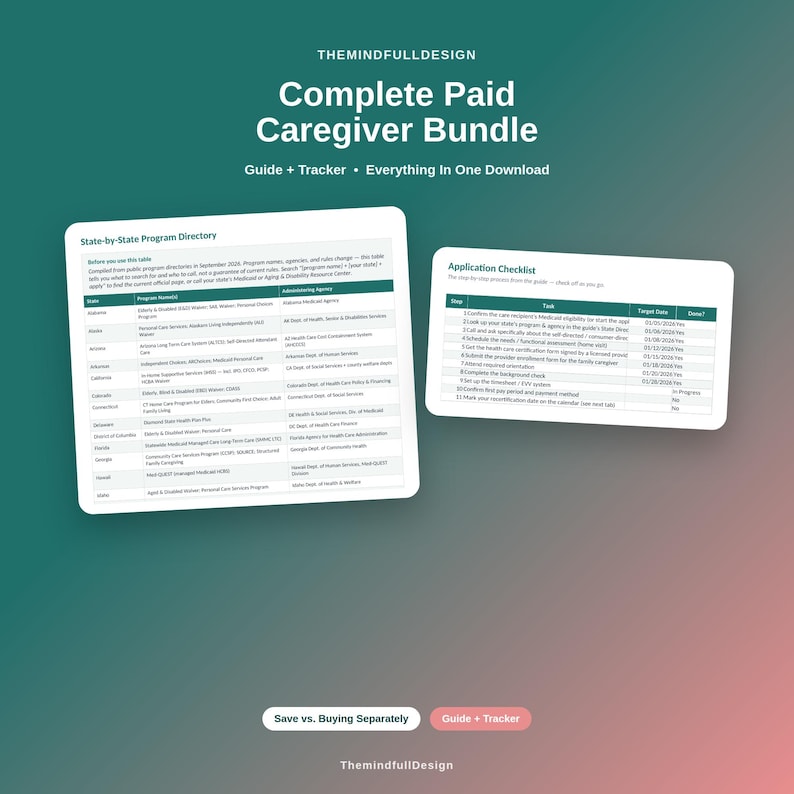
Here’s the part most unpaid caregivers never get told: in every state, there are Medicaid-funded programs — In-Home Supportive Services (IHSS) in California, and similarly structured programs under different names everywhere else — that pay a family member to provide the exact care they’re already providing for free. The eligibility rules, pay rates, and application process are different state to state, which is exactly why so many people never apply. It reads like a maze until someone lays out the steps in order.
A Complete Paid Caregiver Bundle that walks through the program guide plus a tracker spreadsheet for logging hours matters here for a specific reason: most paid-caregiver programs require documented proof of the care you’re providing — dates, tasks, hours — before they’ll approve or reimburse anything. Caregivers who’ve been doing this unpaid for months usually have zero records, because nobody tracks hours for a job they didn’t think of as a job. Starting that log this month, during Family Caregivers Month, means you have real documentation by the time you actually apply.
Why So Many Caregivers Don’t Even Call Themselves That
AARP’s research flags something that explains a lot of the above: about 40% of people providing this kind of care don’t identify as “a caregiver” at all. They think of it as just being a good daughter, a good husband, a good neighbor. That framing feels generous, but it has a real cost — if you don’t see yourself as a caregiver, you don’t go looking for caregiver resources, caregiver support groups, or caregiver pay programs, because none of that language feels like it’s describing you.

Add to that: 78% of caregivers say they need more help just finding information about what services and support even exist. That’s not a knowledge problem on the caregiver’s part — it’s a navigation problem baked into how fragmented these systems are. Nobody hands you a map when you start driving your dad to dialysis three times a week.
Where to Actually Start This Month
You don’t fix a trillion-dollar systemic gap with a Tuesday afternoon. But you can fix your own version of it, and November is as good a prompt as any to actually do it instead of meaning to.

- Build one binder with every medical, financial, and password detail a hospital or bank might ask for — before you need it at 2am.
- Start logging hours and tasks now, even loosely, in case you ever apply for a paid-caregiver program.
- Look up your state’s Medicaid-funded home care program by name — IHSS, personal care services, consumer-directed care — because “I probably don’t qualify” is a guess, not an answer.
- Say the word “caregiver” out loud about what you’re doing. It’s the password that unlocks the resources built for exactly this.
The $1 trillion number is abstract. The binder you don’t have, the hours you’re not logging, and the program you’ve never looked into are not. Those are fixable this month, starting with whichever one has been sitting on your mental list the longest.